Constructed Epic: Human Token Swarm

Epic Box

Foreword

I reference Human Token Swarm decks all of the time. This is my current version.

First Posted Deck List

HumanTokenSwarm

Evil (6)

Slow (2)
2x Drinker of Blood

Fast (2)
2x Zealous Necromancer

0-Cost (2)
2x Wither

Good (42)

Slow (6)
3x Rabble Rouser
3x The People’s Champion

Fast (23)
3x Forced Exile
3x Inheritance of the Meek
3x Insurgency
2x Quell
2x Royal Escort
3x Secret Legion
2x Standard Bearer
3x Urgent Messengers
2x Vital Mission

0-Cost (13)
3x Blind Faith
3x Courageous Soul
3x Paros, Rebel Leader
1x Priestess of Angeline
3x Revolt

Sage (9)

Slow (0)

Fast (6)
3x Lesson Learned
3x Wave of Transformation

0-Cost (3)
3x Arcane Research

Wild (3)

Slow (0)

Fast (2)
1x Battle Cry
1x Surprise Attack

0-Cost (1)
1x Flash Fire

First Shot Explanation

Human Token Swarm decks are nasty. They can do 30+ damage in one turn with nothing starting in play and just 3 cards (Secret Legion and any 2 of Courageous Soul, Paros Rebel Leader, or Revolt). Going second, I have won on my first turn of the game with this deck (Standard Bearer on his turn. Paros on my turn, and then I slow rolled out Secret Legion and Revolt trying to draw out removal without over-committing.) If you aren’t prepared for this deck, it can crush you.

One of the most devastating parts of the deck is Drinker of Blood. If you have a lot of tokens out and then Drinker on your turn followed by Flash Fire or Wither, you can just win. Or, as one member of the Epic Card Game Fan Page on Facebook laid out: Rabble Rouser on your turn. If your opponent doesn’t remove it, Secret Legion at the end of their turn and expend Rabble Rouser. On your next turn, expend Rabble Rouser, play Drinker, and then Flash Fire/Wither for 60 damage and 60 health.

The problem with this deck is that it can be countered (or at least disrupted) by a lot of cards: Surprise Attack/Final Task-> Angel of Death/Frost Giant/Time Walker, Plague, Wither, Zombie Apocalypse, Ceasefire, Secret Legion, Blind Faith (strips blitz, would not strip buffs from cards like Revolt), Insurgency, Quell, Ice Drake, Stand Alone, Wave of Transformation (not great but still saves you for a turn), Fireball, Flash Fire, Hurricane, Lightning Storm, Wolf’s Call, Draka’s Fire, and other cards disrupt it to significantly smaller extents.

Every deck needs to run at least a few of these cards to deal with this and similar decks. If you don’t, you run the risk of just losing instantly. If you don’t think anyone will run this deck, you are welcome to take that gamble. Thankfully, a lot of these cards are just super strong anyway.

I argue that Insurgency is the most important card in this deck (aside from Drinker of Blood) because it prevents the most answers (Flash Fire, etc.).

I don’t think I have seen anyone else include Zealous Necromancer, and I am still not sold on it. I have liked it the situations I have played it though. Conversely, I do not include Deadly Raid or multiple Battle Cries because I don’t think they prevent enough answers. I feel that Dark Leader is a bit weak too. The Risen could be quite interesting in combination with Zealous Necromancer.

Royal Escort is a new addition to the deck. It literally only answers Wither, but it is a nice ambush setup before the attack. It can also protect your Rabble Rouser. Unfortunately, it would prevent you from targeting your own human tokens with Wither for the Drinker Combo.

I’ve been holding off posting this deck because I originally thought Human Token Swarm decks would be the deck to beat. While I’m still considering playing it at Origins, I think enough decks will be running counters to it that it probably wouldn’t go all the way.

6/10/16 Fine Tuning

Removed: -2 Forced Exile, -2 Vital Mission, and -1 Priestess of Angeline

HTSRemove

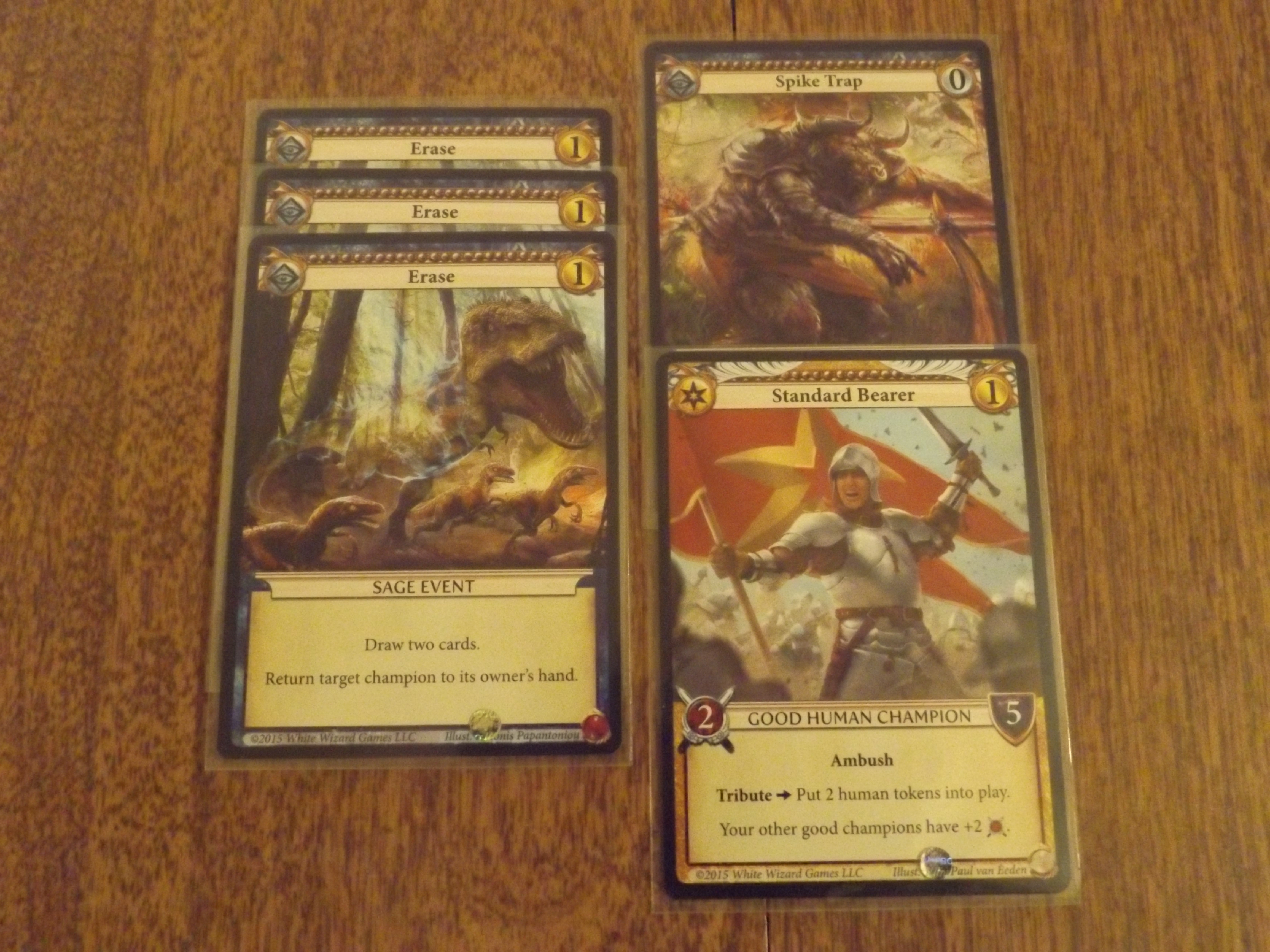
Added: +1 Standard Bearer, +3 Erase, and +1 Spike Trap

HTSAdd

I am in the process of fine tuning all of the decks I expect to either play or play against at Origins. After doing some more testing with this deck, I decided to focus this deck more around winning directly with a combo. To this end, I removed the Vital Missions and most of the Forced Exiles because they provide a small enough edge for an opponent to survive. Erases were added instead because I don’t want the game to go long, and the draw 2 is a huge deal; if the first assault doesn’t win you the game, you need to reload for a second one.

Priestess of Angeline doesn’t offer enough to warrant a card spot, especially since this deck ideally wants to win in the first 3 turns. I also might not have 2 cards to recycle.

Standard Bearer has been very nice. I underestimated the static +2 offense buff and the fact that you can set it up on your opponent’s turn.

Spike Trap is another way to trigger Drinker: play Drinker, attack with all of my human tokens, immediately play Spike Trap to break them all. I would prefer another Flash Fire, but I don’t currently have the Wild 1-cost cards to support it.

I might, however, add some Flame Strikes etc. for finishing off an opponent. In that case, I would bring at least 1 more Flash Fire.

Epic Focus: Origins

Epic Box

Origins is coming up with 4 Epic Card Game tournaments, one every day June 16, 2016 – June 19, 2016; I plan on competing in all of them. (I missed pre-registration though.)

So, until Origins, I am going to be focusing all of my posts on Epic, which means no board game reviews for the next 2 weeks. I am also going to try and play as much Epic as possible.

Since an App/Online version of Epic does not yet exist, I have been playing on Tabletop Simulator and Cockatrice. For an explanation of Cockatrice, you can check out Epic Insights’ post here. I try to stay in the discord channel so I can be reached. My steam name is RiotOfficer with a Sea Titan avatar, feel free to reach out if you would like to play. (Once an app/online version exists, assuming one will, I will be transferring over to that fully, and I will plan to stream at that point too.)

If you do play me, you will almost certainly play against one of my potential tournament decks. Not all of them have been posted yet.

In addition, I plan on posting at least some updates after each day at Origins. I hope to collect deck lists/limited pools, pictures of my opponents, and results from the tournaments (with their permission of course).

Finally, each day I plan on posting a picture of myself before heading out, so feel free to come up and say hi. As consistent readers know, I can and do discuss gaming generally and Epic specifically at great lengths.

Let me know if there are any requests Origins related.

Constructed Epic: Army of the Apocalypse

Epic Box

Foreword

This deck was another attempt at a solid Evil deck.

First Shot Deck List

Army Of The Apocalypse

Evil (34)

Slow (9)
3x Angel of Death
1x Drinker of Blood
2x Necromancer Lord
2x Succubus
1x The Gudgeon

Fast (16)
3x Army of the Apocalypse
3x Drain Essence
1x Final Task
3x Medusa
1x Necrovirus
2x Plague
3x Zombie Apocalypse

0-Cost (9)
1x Corpse Taker
3x Guilt Demon
1x Heinous Feast
2x Plentiful Dead
2x Wither

Good (0)

Sage (22)

Slow (11)
1x Blue Dragon
3x Djinn of the Sands
3x Juggernaut
1x Time Walker
3x Winter Fairy

Fast (5)
3x Crystal Golem
2x Lying in Wait

0-Cost (6)
3x Amnesia
3x Arcane Research

Wild (4)

Slow (0)

Fast (3)
3x Surprise Attack

0-Cost (1)
1x Flash Fire

First Shot Explanation

This deck is currently just a mash together of a couple ideas. It needs to be refined, but I’m still deciding in which direction to refine it.

The two generically incredibly powerful cards in Evil are Angel of Death and Medusa. Both leave a body behind and function as highly effective removal. These are the cards I started designing around.

Another strong aspect of Evil is off-turn removal in general (Medusa, Necrovirus, Bitten, Drain Essence, etc.). However, Evil is weak in draw. To play to this strength and negate the weakness, I thought I would include strong slow card draw champions (Winter Fairy, The Gudgeon, Djinn of the Sands, etc.) to draw to my removal.

From that point, I thought it would be powerful to recur the slow card draw champions with Necromancer Lord (another ridiculously powerful Evil card). This led me to want Crystal Golem so Necromancer Lord could effectively be Expend: Draw 2 cards, if needed. The Crystal Golem (and Winter Fairy) then worked nicely with Army of the Apocalypse for draw. Djinn of the Sands and Juggernaut also work with Army of the Apocalypse as inherently blitzing champions.

Amnesia, Guilt Demon, and Heinous Feast are basically essential for Army of the Apocalypse decks. Zombie Apocalypse is also better with discard hate.

Drinker of Blood either Surprise Attacked in followed by Zombie Apocalypse then Wither/Flash Fire or with Army of the Apocalypse is nice.

So, these are the directions I’m experimenting with currently. It’s possible that I could change the slow champion number or mess around with the removal a bit. It will be interesting to see whether Army of the Apocalypse is more effective as a tempo/card draw play or as a big, all-in, blitz for the win play.

Specter Ops Review

Specter Ops Box

Foreword

Specter Ops is a team game with hidden movement, deduction, and player powers.

Hidden Movement

Goal

One player is the Agent. Their goal is to stealthily complete objectives and escape.

Everyone else is a Hunter. Their goal is to stop the Agent.

(In a 5-player game, one Hunter is a Traitor secretly helping the Agent.)

Specter Ops In Progress

Game Overview

The Agent spends the game secretly moving around the board completing 3 of 4 objectives and then escaping. The Hunters must track the Agent and reduce her health to 0 or delay her for 40 turns.

Both the Agent and the Hunters are represented by miniatures on the game board. The Hunters visibly move their miniatures, but the Agent does not. Instead, the Agent writes down her moves and only uses her miniature to denote where she was last seen.

At the start of the game, the Hunters select characters with special Agent-hunting abilities. Then, the Agent selects her own character and 3 pieces of equipment to help evade the Hunters.

How to Play

Setup

Specter Ops Setup

Objectives

There are 4 objectives, and the exact location of each is randomly determined at the start of the game. The 4 potential objective-location groups are shown on the Agent’s movement sheet. For each group, roll a die. Circle the corresponding location on the Agent’s movement sheet and place a mission token (blue side up) on the board at that space.

Specter Ops Objective

Vehicle/Hunters

The Vehicle starts on space K17, and all of the Hunters start inside it. To represent the Vehicle on the game board, there is a Vehicle token. To represent the Hunters in the Vehicle, there is a Vehicle card.

SpecterOpsVehicle

Additional 4 or 5 Player Setup Rules

Line of Sight

During the Game, the only way the Agent can be seen is if she is in Line of Sight to a Hunter miniature. To be in Line of Sight, the Agent and Hunter must be in the same row or column, and there can’t be a structure in between them.

For example, if the Agent is on spot Q5 and a Hunter is on the spot Q10, the Hunter has Line of Sight and the Agent is visible. If the Hunter was on spot Q12, the Hunter would not have Line of Sight and the Agent would not be visible.

Specter Ops LOS

If the Hunter is in a road, the hunter can see both rows or columns in that road.

Specter Ops Road Vision

Agent

The Agent takes her turn, and then the Hunters take their turn.

Movement

At the start of each turn, the Agent may move up to 4 spaces. Diagonal movement is allowed. Moving through a Hunter is not allowed. Since the Agent doesn’t physically move a piece on the board, she must write where she ends her move on her movement sheet (Q5 for example). After moving, the Agent announces that she has moved.

SpecterOpsQ5

Moving 2 or less can be beneficial because it nullifies the Hunters’ Motion Sensor, explained in the Hunter section.

If, before moving, she starts orthogonally or diagonally adjacent to an objective, she may complete that objective by flipping it over to its red side.

SpecterOpsCompletedObjective

If, while moving, she passes through a space that a Hunter has Line of Sight to, she must place the Last Seen marker and her miniature in that space.

SpecterOpsLastSeen

If, after moving, she is in Line of Sight of a Hunter miniature, she must place her miniature on that spot.

Specter Ops Visible

Finally, if after moving she has completed 3 objectives and is on one of the exit points, she wins.

Specter Ops Exit

Character and Equipment

At the start of the game, after the Hunters choose their characters, the Agent chooses her character. Each character has a special ability.

Specter Ops Character

The Agent also gets to choose 3 Equipment cards. There are four generic Equipment cards (Adrenal Surge, Flash Bang, Smoke Grenade, and Stealth Field) with two copies of each. In addition, each character has a character specific Equipment card that they may choose. Each Equipment card may only be used once in a game, except for some of the character specific ones that may be used twice.

Specter Ops Equipment

Equipment may either be used before or after moving, but only 1 Equipment card may be used in a single turn. Each Equipment card explains how to use it. Most of the Equipment cards must either be revealed or rotated to show when they are used. When any Equipment card is used, the Agent must write its initials on her movement sheet.

SpecterOpsInitials

In a 4 or 5 player game, the Agent chooses 5 equipment cards and has 2 extra health.

Hunters

At the start of each Hunter turn, the Hunters must decide their activation order.

A Hunter may either move, use a character ability, or activate the Motion Sensor (if in the vehicle and if it hasn’t moved this turn). Then, the Hunter may attack the Agent, if the Hunter is not in the vehicle and the Agent is in Line of Sight. Once the first Hunter’s activation is finished, the second Hunter’s activation begins, etc.

Movement/Vehicle

Most Hunters may move up to 4 spaces in a turn, if not in the Vehicle. The Vehicle may move up to 10 spaces in a turn, but it must remain in the double column/row roads. Entering or exiting the Vehicle ends a Hunter’s movement.

Specter Ops Roads

To move the Vehicle, a Hunter must start the turn in the Vehicle. The Vehicle’s movement may be split between multiple Hunters’ activations. If one Hunter moves the vehicle 6 spaces, a second Hunter could move the vehicle up to 4 more spaces. A Hunter may exit the vehicle after using it.

Instead of moving, a Hunter may either use a Character ability or the Motion Sensor. For example, instead of moving, The Prophet may use the post-cognition Character ability to make the Agent announce where she was two turns ago.

If a Hunter starts the turn in the Vehicle, that Hunter may use the Motion Sensor. The Motion Sensor may not be used if the Vehicle already moved that turn, and the Vehicle may not be moved if the Motion Sensor was already activated that turn.

When the Motion Sensor is used, if the Agent moved 2 or less spaces on her turn, she says “no motion detected.” If the Agent moved more than 2 spaces on her turn, she must say where she is in relation to the vehicle.

For example, if the Vehicle is on N9 and the Agent is on G9, the Agent must say West. If the Agent was on G10, Southwest.

Specter Ops Motion Sensor

After Moving

After moving, the Agent will either be in Line of Sight or she won’t.

If the Agent isn’t in Line of Sight, she must say “clear.”

If the Agent is in Line of Sight, she must place her miniature on her current location. Then, if the Hunter isn’t in the Vehicle, that Hunter may attack the Agent.

If the Agent and Hunter are on the same space, the Hunter automatically deals 1 point of damage to the Agent. Otherwise, count how many spaces away the Agent is from the Hunter (including the Agent’s current space). Then roll a die.

If the roll is a 1, the attack automatically misses.

If the roll is a 6, roll an extra die and add the rolls together. Every extra die that rolls a 6 grants another extra die.

If the total die roll is equal to or greater than the number of spaces, deal 1 point of damage to the Agent.

Specter Ops Attack

If the Agent is reduced to 0 health, the Hunters win the game.

Stunned Hunter

If the Agent stuns a Hunter with a Character ability or Equipment card, that Hunter may only move 2 spaces on their next turn, cannot use Character abilities, and cannot attack the Agent. To show a Hunter has been stunned, put a Stun Marker on the Hunter card; remove it at the end of the turn.

Specter Ops Stun

A Hunter may not be stunned while in the Vehicle.

5 Player Traitor

Conclusion

I love this game. I enjoy playing the Agent and the Hunter(s). Hidden movement is cool. As the Agent, trying to outsmart your opponents through feints, bluffs, and counter-bluffs is awesome. As the Hunter(s), locating, cornering, and attacking the Agent is incredibly satisfying. The addition of the Equipment and Character abilities also adds a lot to the game.

For example, with the Smoke Bomb you can make a 3 by 3 area within 4 spaces obstruct vision. So, you could throw it out at a road to block LoS when you run past that road. You could also throw it down and then move into it; you can only be hit if your opponent is on top of you in that scenario. (If you are The Cobra, you stun any Hunter on top of you.) Or, you could bluff; throw it out to block LoS in one direction, and then go in a completely different direction. That last one is my favorite, but I do like the idea of double Smoke Bomb Cobra.

Specter Ops Cobra Smoke Grenade

Unfortunately though, I have only met 1 other person who enjoys it as well. (After 3 games one of my other players no longer likes the game.) This game is certainly not for everyone, and there are 2 main reasons why it might turn a player off.

Some people feel overwhelmed and have a lot of trouble deciding what to do initially, particularly for Hunter players. Since, at the start of the game, you have 0 information about which Agent character is being played, what their equipment is, or where they went. This has really turned off multiple players. A few pieces of advice to avoid this for hunters are:

  • Use the roads for vision. Place your miniatures in such a way that the Agent will be forced to run past at least one of them. This is excellent for initially establishing where the Agent went.
  • Pick Prophet for your first game. Prophet’s post cognition ability makes it impossible for the Agent to completely juke (outmaneuver to stay hidden) the Hunters.
  • Don’t be afraid to not move on your turn if you are in a good position.

The second problem some people have with the game is they find it boring. As the Agent it isn’t really boring because you have to constantly plan your moves. As the Hunters, if the Agent is consistently moving 2 spaces a turn or spends turns waiting, it can get boring if you just wait for them to show themselves. This has never been an issue for me because I am highly competitive, and I have no problem waiting if I think it is a good move. But, I understand that this can be a boring, low action situation for people who just want to be engaged and have a good time.

I have not had a chance to play with the Traitor, but it does intrigue me. I have only played 2 and 3 player games so far, but I like the game so much that I already want to recommend it. For people that don’t like deduction games, I would avoid it, but for competitive players that love trying to outsmart their opponents, I highly recommend it.

Kemet Preview

Kemet Box

Kemet is an almost no-luck, high-interaction game. By acquiring unique powers, players command massive creatures, attack their opponents, and defend temples in a way different from every other player. There are plentiful strategies to pursue, and the game actually rewards attacking.

Kemet In Progress

Kemet Close Up

Kingsburg Review

Kingsburg Box

Foreword

Kingsburg is a 2-5 player worker placement game that uses dice as its workers. This mechanic allows for plentiful options without overloading the players.

Worker Placement

Goal

The goal of the game is to build buildings, score points, and fend off yearly attacks.

Kingsburg In Progress

Game Overview

The game is divided into five years. Each year has three Productive Seasons where players roll dice, influence advisors, and build a building (the meat of the game). These are separated by minor, kingly interventions, and at the end of the year, there is an attack that can potentially lose players points.

How to Play

Each year is divided into 8 phases:

  1. Aid from the King
  2. Spring Productive Season
  3. The King’s Reward
  4. Summer Productive Season
  5. The King’s Envoy
  6. Autumn Productive Season
  7. Recruit Soldiers
  8. Winter – The Battle

Kingsburg Calender Track

Productive Season

The bulk of the game takes place in the three Productive Seasons (Spring, Summer, and Autumn). In these Productive Seasons, players roll their dice, influence advisors, and optionally build a building.

Roll the Dice

All players roll their three dice. The player with the highest combined total will be last to influence an advisor in this season. To represent this, place that player’s colored disk at the bottom of the Turn Order Chart. The player with the next highest combined total is placed second to last. Repeat until everyone’s disk has been placed.

KingsburgTurnOrderChart

Influence Advisors

The advisors range from 1 to 18. Players use their dice to select (influence) these advisors. Each advisor grants the selecting player resources. The higher the number of the advisor, the more resources it grants.

KingsburgAdvisors

The first player on the Turn Order Chart selects first. They can use one, two, or all three of their dice to select an advisor with a matching number.

For example, if they rolled a 3, 5, and 6. They could use all of their dice to select the 14-advisor. They could use two dice to select the 8, 9, or 11-advisor. Or, they could use one die to select the 3, 5, or 6-advisor.

Once the first player selects an advisor, the second player selects an advisor, etc. until all players, in order, select an advisor. After everyone has selected an advisor, players can potentially select a second advisor, in turn order. Any dice that weren’t used on the first selection, can be used for this second selection. For anyone with a die remaining after the second selection, there is a third/final selection. So, a player could either get one high numbered advisor or multiple low numbered advisors. The only caveat is that no advisor can be selected more than once in a season.

Build Buildings

After influencing advisors to gain resources, each player may use those resources to build a building.

Kingsburg Province Sheet

To build a building, you must turn in resources matching the cost in the circle on your Province Sheet. To show that you built a building, place one of your Building Tokens over the cost. You then immediately gain the victory points to the right of the flag (advance your token on the Scoring Track around the board). In addition, you gain the effect in the text for the rest of the game.

For example, if you spend two gold to build the Statue, you immediately gain three victory points, and for the rest of the game, anytime you roll the same number on all of your Productive Season dice, you may reroll one of those dice.

At the start of the game, you may only build a building in the leftmost I column. In order to build a building in the II, III, or IV column you must build each building in that row in the preceding columns first. For example, if you want to build the Embassy, you would first have to build the Barricade, then the Crane, then the Town Hall. Once those are built, you may build the Embassy.

The Rest of the Year

Everything else that happens in the year revolves around the Productive Seasons.

1) Aid from the King

The player with the least built buildings gains a white die for the next Spring Productive Season. This die is rolled in the Spring Productive Season with the rest of your dice. You can use that white die with at least one of your other dice to select an advisor. (The bonus white die does count for determining turn order in the Productive Season.)

If two or more players are tied for the least amount of buildings, the tied player with the least goods (gold, wood, or stone) gains the white die. If still tied, all tied players gain one good of the their choice.

In the first year of the game, since all players will be tied in buildings and goods, all players gain one good.

2) Spring Productive Season

**See Productive Season above**

3) The King’s Reward

The player with the most built buildings gains a victory point. If there is a tie, all tied players gain a victory point.

4) Summer Productive Season

**See Productive Season above**

5) The King’s Envoy

The player with the least built buildings gains the King’s Envoy. In case of a tie, the tied player with the least goods gains the King’s Envoy. If still tied, no one gains the King’s Envoy.

KingsburgKingsEnvoy

The King’s Envoy can be used in a Productive Season to either:

A) Select an advisor a second time in a Productive Season

or

B) Build a second building in a Productive Season

For selecting an advisor a second time, the advisor can either be already selected by a different player or by yourself. Place the King’s Envoy marker next to your dice to show that you are using it.

For building a second building, you must follow the column rule (build from left to right) and have the resources to build both buildings.

When you use the King’s Envoy, return it to its starting spot. If the King’s Envoy is not used by phase 5 of the next turn, the King’s Envoy is reassigned.

6) Autumn Productive Season

**See Productive Season above**

7) Recruit Soldiers

Phase 7 directly relates to phase 8. I recommend reading phase 8 first.

In turn order defined by the Autumn Productive Season, players may recruit soldiers by turning in two goods (gold, wood, stone) per soldier. Players may recruit as many soldiers as they can afford. The goods could be the same or different.

Soldiers do reset to zero at the end of each year.

8) Winter – The Battle

Before the end of each year, one of five random enemies attacks. Each player is attacked by the same enemy.

KingsburgEnemies

Each player has a combat value and each enemy has a strength. If a player’s combat value exceeds the enemy’s strength, that player gets a reward. If a player’s combat value is less than the enemy’s strength, that player is penalized. If a player’s combat value ties the enemy’s strength, nothing happens.

A player’s combat value is determined by their soldiers, buildings, and the king’s reinforcements. Each soldier you have on the Soldier Chart adds 1 combat value. Buildings like Guard Tower, Fortress, and Farms add or subtract combat value. For the king’s reinforcement, one player rolls a die and every player adds that number to their combat value.

For example, Blue has two soldiers on the Soldier Chart for +2.
Blue has Guard Tower (+1), Blacksmith (+1), Palisade (+1), and Farms (-1) for a net +2.
For king’s reinforcements, a 3 is rolled for +3.
In this situation, Blue has a combat value of 7.

KingsburgCombatValue

In addition, the player that beats the enemy by the most, gets a bonus victory point. In case of tie, all tied players get the victory point. If no player beats the enemy, no one gets the victory point.

End of Year

At the end of the year, advance the Year Track by one and place the season token back at Aid from the King. At the end of year 5, the game is over.

Winning the Game

The player with the most points at the end of the game is the winner. In case of a tie, the tied player with the most goods remaining wins. If still tied, the tied player with the most built buildings wins.

Conclusions

I enjoy Kingsburg because it provides me with a lot of strategic choice while still being fun for the family. I like being able to plan out exactly which buildings I am going to get in which order. Then, based on that, I like figuring out the best way to optimize my dice rolls in the Productive Seasons, taking into account what resources I need and what advisors my opponents might go after. Watching my strategy unfold as planned can be incredibly satisfying.

I have also played Kingsburg with minimal planning. In these games, I just start off with a general idea, and I leave myself open to potentially disrupt my opponents in the Productive Seasons. Whether or not I do disrupt my opponents, building buildings on a whim can be quite satisfying as well.

With regard to the dice as workers mechanic, I am a fan. This mechanic randomizes which of the 18 advisors you can potentially choose from each Productive Season; this keeps the game interesting because you have to decide the best potential combination of these random elements. I much prefer dice randomizing my options than determining success or failure. While consistently getting high rolls can be beneficial, a player won’t straight out lose for not rolling the highest consistently.

The thing I dislike the most about this game is that certain enemies can destroy your best building. If you don’t defeat specific enemies, generally the lower strength enemies of the year, you can lose your rightmost building. I really dislike this in theory because it allows for massive feast or famine strategies. You can completely ignore combat value bonuses, and if the King’s reinforcements are consistently high, you are in a better position than the person that defended themselves. If the King’s reinforcements are not high, you fall dramatically behind your opponents that prepared their defenses. In addition, no one likes losing things. Thankfully, this has not actually been much of an issue in the games I have played. The odds of losing a building are very low, but we basically all protect ourselves form them anyway. So even though this idea worries me, I still enjoy and recommend the game.

If you do like the game, I highly recommend checking out the first expansion, To Forge a Realm. The expansion adds more buildings and randomizes which ones you might start with each game. This alone significantly increased my enjoyment of a game I already liked. There is also a reworked combat variant that replaces king’s reinforcements that I look forward to trying. The added player specific powers also seem like they could add a lot.

Overall, I enjoy the game, recommend trying it, and if you like it, I highly recommend the expansion.