Foreword

At Origins 2017, I went 2-0-2 in the random 60 swiss rounds for a spot in top 4. (One unintentional draw in round 2 and one intentional draw in round 4.)
Random 60
Random 60 is a “limited” Epic Card Game format where you build your deck from a random pool of cards at the beginning of the event. In Random 60, each player is given their own unique list of 60 cards with between 13 and 17 cards of each alignment. Each player uses only the cards on their list to construct a deck of exactly 30 cards. (Constructed Epic deck-building restrictions do not apply, you may include as many 0-cost cards as you have access to in your pool.)
60 Card Pool

If you don’t like your first card pool, you are able to mulligan. If you do, you get a new list of 56 cards with between 12 and 16 cards of each alignment. If you don’t like your second pool, you are stuck with it.
Would you mulligan this pool? Why or why not?
First Pass
When I first go over my list, I look for
- auto-includes (star:
 )
) - strong alignment-independent cards (solid arrow:
 )
) - strong alignment-dependent cards (dashed arrow:
 )
) - strategy-dependent cards like Revolt (line:
 )
) - effectively unplayable cards (line through:
 )
) - generally unplayable cards (dashed line through:
 )
)


All cards without a mark are viable, but not incredible.

Wild
 Wild is my most rewarding alignment here. By committing to Wild, I gain access to 4 alignment-dependent powerful cards, in addition to 5 generically powerful Wild cards and 7 other playable Wild cards. Draka’s Enforcer is one of the best loyalty 2 cards in the game, while Brachiosaurus, Draka Dragon Tyrant, and Pyrosaur are all powerful as well. Below are cards notably absent from my Wild pool to help analyze how strong of a Wild deck it could be.
 Notable Wild-commitment cards I do not have access to: Fire Spirit, Raging T-Rex, Strafing Dragon, Scarros Hound of Draka, Spore Beast
Notable Wild-generic cards I do not have access to: Ankylosarus, Feeding Frenzy, Wolf’s Bite, Kong, Lash/Rage, Surprise Attack, Triceratops, Den Mother, Hunting Pack
Sage
 My Sage pool has a few incredibly powerful cards, but very little incentive to commit to it as my primary alignment. Amnesia, Ancient Chant, and Thought Plucker are 3 incredibly high-value cards to get. There are also multiple other cards I’d be happy to include.
Notable Sage-generic cards I do not have access to: Fumble, Erase, Forcemage Apprentice, Muse, Ogre Mercenary, Sea Titan, Spike Trap
Evil
 Zannos is my only incentive to commit to Evil, and I have multiple Evil cards I wouldn’t really want to play, making him worse. Aside from that though, Winged Death is incredible in addition to multiple other cards.
Notable Evil-generic cards I do not have access to: Raxxa’s Curse, Dark Knight, Drain Essence, Little Devil
Good
My Good pool is fairly lack-luster. I have some strong human token cards, but I don’t have the critical mass to make that particularly viable.
Notable Good-generic cards I do not have access to: Blind Faith, Urgent Messengers, Angel of Light, Brave Squire, Inner Peace, Palace Guard, Silver Dragon, Angel of the Gate, Rescue Griffin
Overall
 I was incredibly happy to see: Amnesia, Lightning Storm, Lightning Strike, supported Draka’s Enforcer, Smash and Burn, and Grave Demon. However, as I looked through the list, I noticed a lack of strong reestablishing champions, namely Kong, Sea Titan, Palace Guard, or supported Medusa/Angel of Death. (I forgot I had Winged Death).
 In addition, the lack of Feeding Frenzy is a huge hit to Wild decks with Pyrosaur/Draka. Further, the absence of Lash/Rage makes it difficult for big Wild champions to convert their imposing stats into damage. Due to missing these critical components of the strongest Wild decks, I decided to mulligan for something hopefully better.
While I did not consider it at the time, another reason to consider taking a mulligan on your pool is if you don’t get 10+ playable 0-cost cards.
Mulligan Card Pool

You are not allowed a second mulligan, so I had to make this work.
First Pass

Wild
 This Wild pool only has 2 cards that reward me for going with a Wild alignment: Brachiosaurus and Pyrosaur (not a huge fan of Hunting Raptors in limited formats especially with Lightning Strike‘s existence).
Notable Wild-generic cards I do not have access to: Wolf’s Bite, Kong, Surprise Attack, Triceratops, Den Mother
Sage
 Once again, not much reason to go primarily Sage, but Blue Dragon + Forcemage Apprentice makes my Feeding Frenzy great. Ogre Mercenary and Citadel Scholar are also incredibly strong cards in limited. (They can establish a small threat for you to an empty board without decreasing your hand size.)
Notable Sage-generic cards I do not have access to: Ancient Chant, Amnesia/Erratic Research, Fumble, Muse, Sea Titan, Spike Trap, Thought Plucker
Evil
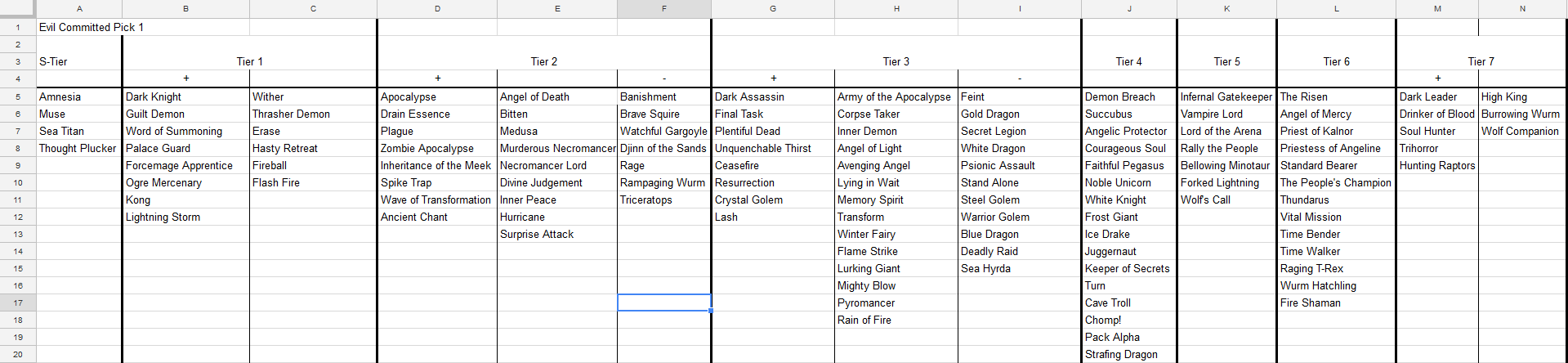
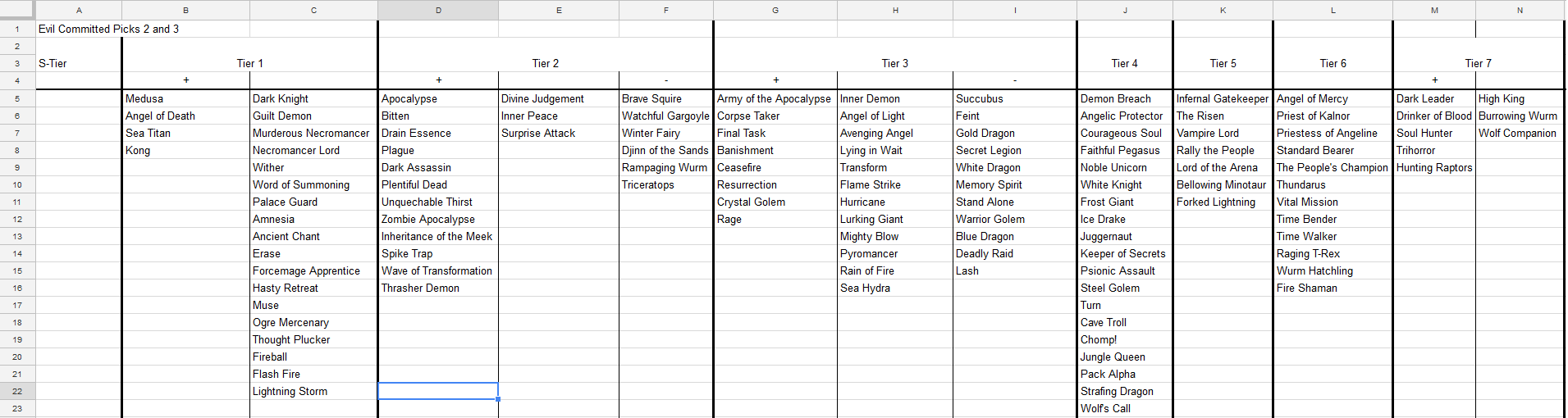
 My Evil pool is sick. Medusa, Murderous Necromancer, and Necromancer Lord are 3 of the most powerful Evil cards in the game, and they have been doing work for me in core-only. Angel of Death is also great as a reestablishing card. Spawning Demon can help keep up your flow of token threats as well. Combine these with the potential of Demon Breach, Infernal Gatekeeper, Necrovirus, and Hunting Pack for a strong token deck.
 Notable Evil-commitment cards I do not have access to: Raxxa’s Displeasure, Reaper, Raxxa Demon Tyrant, Plentiful Dead, Zannos Corpse Lord, Rift Summoner
Notable Evil-generic cards I do not have access to: Grave Demon/Heinous Feast, Raxxa’s Curse, Dark Knight, Drain Essence, Little Devil, Final Task, Guilt Demon, Wither, Word of Summoning, Winged Death
Good
 Inheritance of the Meek in an Evil token deck is absurdly strong. Also, due to my considerable time spent playing Core-Only on the app, I highly value health gain in limited so I was happy to get Inner Peace and Angel of Light.
Notable Good-generic cards I do not have access to: Blind Faith, Urgent Messengers, Brave Squire, Palace Guard, Silver Dragon, Angel of the Gate, Rescue Griffin
Overall
This deck has a lot more power than the last one due to the insane Evil core. However, the only discard pile banish card in my entire pool is Corpsemonger. Therefore, I must expect to only win by killing my opponent every game. (I take some responsibility for this, due to being quite vocal about the importance of mass-discard pile banishment.)
Mulligan List Second Pass
Once I complete my first pass with the deck list provided, I gather all of the cards I can play and divide them into cards I want to play (dotted star), cards I might play (unmarked), and cards I won’t play (strikethrough).

Ideally, the cards I want to play will end up close to 30 so I only need to do minimal cuts or additions. Notable cards that didn’t make this first cut:
- Brachiosaurus – Since I wasn’t going primarily Wild, I didn’t really consider it. It might have been able to work in the deck though.
- Rage – With most of my champions being small/tokens, Rage is less likely to provide significant value.
- Mighty Blow – While theoretically strong in token decks because you are more likely to get an unblocked champion through, it is too all-or-nothing for me. Therefore, I’d be willing to add it back in, but would prefer to leave it out.
- Deadly Raid – Another all-or-nothing card I’m not a huge fan of using. However, with no mass-discard pile banish card, I probably should have considered it more seriously than I did.
- Knight of Shadows – A reasonable establishing champion. I’m not sure why I didn’t consider it longer.
- Angelic Protector – In a deck that needs to kill your opponent, Angelic Protector can be fairly solid. Block an attack and then leave a 9 defense airborne champion in play to attack next turn.

Distribution Passes
After the second pass where I largely assemble my deck, the rest of my time is spent refining that deck based on various desired distributions: min draw/recall cards (15), min establishing cards (6), max slow 1-cost champions (10), min 0-cost cards (10), and min loyalty commitment (10).
I also like to have multiple ambush champions (off-turn gold-punishers), a couple blitz champions (on-turn gold-punishers), some burn to finish off opponents with direct damage, targeted removal, and board clears.
Ideally, I only need to use cards I want to play, but I keep my cards I might play nearby in case I need to fill a hole in the deck.
For a more thorough and deliberate demonstration of my random 60 distribution passes, check out my previous Origins and Gen Con Random 60 articles.
Min Draw/Recall
 No matter the format, my minimum number of cards that can either draw/recycle/recall/spend-extra-gold-on is half the cards in the deck. Therefore, in a 30-card deck, I want at least 15. Currently 20 of my 34 cards have some form of draw/recycle/etc not including Inner Peace:
Mythic Monster, Lightning Strike, Hurricane, Flash Fire, Fires of Rebellion, Feeding Frenzy, Ankylosaurus, Inheritance of the Meek, Ceasefire, Noble Unicorn, Demon Breach, Blue Dragon, Citadel Scholar, Erase, Ogre Mercenary, Crystal Golem, Hasty Retreat, Bitten, Inner Demon, and Plague
Since I have over 15, I am able to cut some of those cards that don’t work great with the rest of the deck. At this point, I cut Hurricane and Ceasefire.
 I cut Hurricane because my only champion that lives through it is Mythic Monster. In addition, I have plenty of ambush champions and 0-cost champions that will ideally allow me to maintain a presence on the board consistently. Further, I still have Inheritance of the Meek, Angel of Death, and Plague as board clears. Inheritance doesn’t hit my (or my opponent’s) tokens, Angel leaves a 6/5 airborne body behind, and Plague helps hit Evil loyalty.
 I cut Ceasefire because I can’t afford a card that is entirely passive and doesn’t advance me towards reducing my opponent to 0 health, since I have no mass discard pile banish card. Cutting a Good card hurts Angel of Light loyalty, Noble Unicorn‘s ally ability, and Inner Peace Recall, but all 3 of those cards are strong enough on their own.
Min Establishing Champions
 Regardless of format, I generally want about 1/5 of my deck to be establishing cards. Establishing cards are typically champions with tribute or loyalty abilities that give you an immediate benefit when played, like draw a card or put tokens into play. 0-cost champions can also fill this role because you are able to put a threat into play while retaining your gold to answer your opponent’s play. I like to have 1/5 of my deck be establishing champions because it gives me reasonable odds to have one on the first turn of the game if I have to go first. Not counting Corpsemonger or Thrasher Demon, the deck currently has 8 establishing champions:
 Mythic Monster, Ankylosaurus, Noble Unicorn, Murderous Necromancer, Demon Breach, Infernal Gatekeeper, Blue Dragon, and Crystal Golem (untargetable makes it hard to punish the turn you play it)
Since I have over 6, cutting one is acceptable. Of those options, Infernal Gatekeeper is the weakest and least versatile, so it got cut.
Final Cut
 The last cut is always the hardest. At this point I have all of my mandatory distributions met: draw 18/31, establishing 7-9/31, max slow 1-costs (under 1/3) 6/31, min 0-cost cards (10+ but as high as possible) 11/31, and min loyalty commitment (10+ for limited) 12/31.
Because I want as many 0s as possible, I refuse to cut any of those: Lightning Strike, Flash Fire, Feeding Frenzy, Ankylosaurus, Citadel Scholar, Forcemage Apprentice, Ogre Mercenary, Hasty Retreat, Corpsemonger, Spawning Demon, and Thrasher Demon.
 In order to have a reasonable number of ways to recall Inner Peace, I don’t want to cut any of my 3 other remaining Good Cards: Noble Unicorn, Inheritance of the Meek, and Angel of Light.
I absolutely refuse to cut the most powerful cards: Necromancer Lord, Murderous Necromancer, Medusa, Angel of Death, Erase, and Hunting Pack.
 Blue Dragon works nicely with Feeding Frenzy.
Crystal Golem is a strong off-turn play.
Necrovirus, Inner Demon, and Bitten are all Evil and can produce tokens.
Plague is one of my only 2 remaining board clears and is Evil.
 All that really leaves is 4 cards: Mythic Monster – another superfluous establishing champion, Demon Breach – a generally weaker card, and Flame Strike/Fires of Rebellion – my one-two burn punch. Demon Breach is safe because I need as much token pressure as possible. In the end, Flame Strike gets cut. I decide to lean on Fires because it is better removal, and it can get around The Gudgeon. The rest of the cards are just too important to get me into a state where I can win.

Final Decklist

My biggest worry about this list was the lack of a mass discard pile banish card.
I also had no 1-cost, blitzing, on-turn gold-punishers; howevever, token decks generally do not need these types of gold-punishers as much as other decks. As long as the token deck can keep pushing small amounts of damage through by maintaining a couple small champions in play, getting a big hit in with a gold-punisher isn’t necessary (although it can be devastatingly helpful).
Match 1
 Murderous Necromancer won me my first match. I was able to play it both games, and my opponent was unable to remove it for multiple turns. During those turns, my zombie tokens got through for damage, and my opponent wasn’t able to apply any pressure to me. That 6 defense makes this card so hard to effectively deal with, especially when you add in the fact that it breaks a champion every other turn while giving you a zombie, and it comes with 3 zombies to start.

 The finishing blow for game 2 was my reward for picking Fires of Rebellion over Flame Strike. I was able to get my opponent down to 9ish health while they had a The Gudgeon in play. My opponent did not use their The Gudgeon to block my final demon attack because they thought remaining untargetable to prevent me from using burn to finish them off was more valuable than preventing 4 damage. Fires of Rebellion doesn’t target though.
Match 2
I do not recall anything specific from match 2. I won the first game, and then lost the second game to my opponent decking out after time was called. If my opponent would have recycled less they might have been able to win sooner to force a game 3, but I might have been able to apply enough pressure to beat them if they hadn’t. (And a game 3 probably would have ended in a draw anyway.)
Match 3
My 0’s won me match 3. Throughout the course of both games, every time either one of us board cleared, I was able to immediately play 0-cost champions to reestablish control of the board. From this position I was able to chip down my opponent steadily. Fires of Rebellion was also able to snag me the 2nd game win after time was called.
 The most memorable play of the match was when I attacked with a demon + Sea Titan together in game 2. (I had used Necromancer Lord to return my opponent’s Sea Titan to play under my control, using Sea Titan‘s tribute to bounce my Necro Lord.) I don’t remember the health totals at that point, but I had 2 or 3 demons in play + Sea Titan while my opponent had nothing. After the first demon attack(s) where successful, I decided to attack with my last demon with Sea Titan because I had seen Lying in Wait the first game, I had a feeling my opponent had it in hand, and I wanted to be clever.
 After I made the attack, my opponent said something along the lines of “you know every card in the game don’t you,” essentially confirming Lying in Wait was in their hand. They then ended up ambushing in a champion, and since I had no way to remove it, they used it to block both of my champions, and I believe break my demon. While my line protected my Sea Titan, I don’t think it was correct.
 In that position, my group attack sacrificed almost a guaranteed 4 damage from my demon attacking alone and expended my Sea Titan for little benefit. If I would have attacked with the demon alone and then Sea Titan alone, my opponent could have used Lying in Wait to banish Sea Titan, but then they would have still had to deal with my remaining demon tokens. This also would have given me a window to recall Demon Breach for free enabling me to maintain my ability to play ambush threats.
Another line I could have taken would have been to attack with all of my demons and then pass without attacking with Sea Titan. If my opponent doesn’t spend their gold, I just dealt 8 or 12 damage for free that turn. If my opponent does spend their gold, they are no longer able to Lying in Wait my Sea Titan. Either way, one of these lines would probably have worked out better than my “clever” group attack.
Match 4
The other 2-0-1 record player and I intentionally drew in round 4. Doing so guaranteed us both a spot in top 4 and gave us time to get food.
Overall Match Observation
 One thing I repeatedly found myself doing in multiple matches was spending my gold first, when going second, on the first turn of the game, to break a 0-cost champion and put threat(s) in play. For example, my opponent opens the game by playing Little Devil and attacking. I spend my gold on Medusa or Hunting Pack to break the attacking Little Devil and put threat(s) in play. With my gold down, my opponent is free to play an on-turn gold-punisher; however, I’ve put them in a position where many of them are bad plays.
 If the blitz champion doesn’t have breakthrough or airborne, I have the option of blocking to negate the damage. If the they Lash/Rage their attacking champion, they bring themselves down to 2 cards in hand, a difficult position from which to win. Every time I made this play, I came out ahead because my opponent didn’t have a great response, and because I get the first draw of the game on my first turn.
 That being said, Kong, Winged Death, or worst of all White Knight are a few cards that could have punished my Medusa play effectively while Pyrosaur or Draka could have punished Hunting Pack effectively. However, on turn 1 your opponent is generally less likely to have a great answer, and if they do, it will still probably drop them down to 3 cards in hand, which might be worth it.
In other words, 0-cost champion then pass isn’t as universally great a turn 1 play as I recently thought it was.
Conclusion
Random 60 has been my statistically best format (only 1 match loss over 4 limited qualifiers), so I am happy to answer any questions below. Next in my Origins’ article series I’ll talk about how my hubris helped me lose my top 4 Dark Draft.