Game Reviews, Strategy Articles, and More

Tzaar Review

Tzarr Box

Foreword

This is a rules-light two-player abstract strategy game. I like rules-light 2 player abstract strategy games.

How to Play

Goal

The goal of the game is to eliminate all of a single type of your opponent’s pieces. (There are 3 types.) You do this by capturing their pieces and building stacks with your own. Stacks can only capture stacks of equal or lesser height.

You can also win by making it impossible for your opponent to capture a piece on their turn.

Set Up

You can either randomly set up the discs, use a predefined setup, or alternate placing discs on the board.

TzarrInProgress

Turn

  1. Capture
  2. Capture, Stack, or Pass (Skip this step for the first player’s first turn.)

Capture

Pick a stack of 1 or more disc(s) of your color. Move that stack along a straight line onto an opponent’s stack of equal or lesser height. Remove your opponent’s stack from the board.

Stack

Pick a stack of 1 or more disc(s) of your color. Move that stack along a straight line onto another one of your stacks; this combines the two stacks into one. For determining if you have a disc of a type, only the top disc of a stack counts.

Pass

Do nothing.

Conclusion

This game is simple, elegant, and excellent.

When I previewed this game, I characterized it as a hunting game, and I think that nails it. The ringed piece (Tzaar) is quickly hunted down to just 1 remaining for each side, since each player only starts with 6. To protect their last Tzaar piece, each player will put it on top of a stack. The first player to do that will always have the higher stack, if they stack it every turn. Due to this, that player can chase down their opponent’s stack(s) with impunity.

While this happens, the second player will generally need to shift into hunting their opponent’s second or third rarest pieces (the Tzarra and Tott respectively). So now, the first player is still trying to capture the last Tzaar piece, but they also need to protect their other pieces. The second player, on the other hand, needs to focus on evading the first player’s mega stack while chipping away at the more plentiful discs. This is frequently accomplished by having a few smaller stacks of 2 to 4 discs, as opposed to a big 4+ stack.

Throughout this process, each player can also set traps to ensnare their opponent. For example, player 1 leaves a 3 stack vulnerable. If player 2 captures that 3 stack they might be allowing their opponent to capture one of their stacks. Or, the capturing stack might be put into a position where it can no longer move, neutralizing it. Overall board awareness is critical to winning this game.

Another major decision point in this game is determining when to make a second capture and when to stack. In almost all games, you win the game by capturing your opponent’s pieces. So, capturing moves you directly toward victory. Stacking, on the other hand, is necessary to prevent you from losing; but, it does also give you an offensive edge for capturing. In general, big stacks are better for defense. Multiple small stacks are better for offense.

Everything I have discussed in my conclusion is emergent from the incredibly simple rules. The strategy is surprisingly deep and the better player will usually win. But, there is a lot to pay attention to, and if you neglect something, you can quickly lose. It is easy to focus on attacking and let yourself be eliminated. I really enjoy the back and forth of this game. If you enjoy abstract strategy games like Chess, The Duke, or Push Fight, I highly recommend this game.

Constructed Epic: Duel Decks (Tall vs Wide)

Epic Box

Foreword

In this post, I am including 2 constructed Epic decks. They are designed to be played against each other, with just 3 sets of the base game. The idea to do this came from Harold, a reader and Epic Fan, and it is an excellent idea. With these decks, players can experience Epic constructed play without needing 2 players to have 3 sets each.

In addition, I designed these decks to be largely opposite of each other. The first deck wants to get out big champions and run over their opponent. The second deck wants to get out a lot of champions and run through their opponent.

Tall

Epic Tall

Evil (0)

Good (9)

Slow (0)

Fast (6)
3x Ceasefire
3x Resurrection

0-Cost (3)
2x Brave Squire
1x Watchful Gargoyle

Sage (21)

Slow (11)
2x Frost Giant
3x Juggernaut
3x Sea Titan
3x Steel Golem

Fast (3)
3x Stand Alone

0-Cost (7)
2x Forcemage Apprentice
3x Keeper of Secrets
1x Muse
1x Spike Trap

Wild (30)

Slow (11)
1x Jungle Queen
3x Kong
3x Raging T-Rex
1x Sea Hydra
3x Triceratops

Fast (9)
1x Lightning Storm
3x Lurking Giant
3x Hurricane
2x Surprise Attack

0-Cost (10)
1x Cave Troll
2x Fire Shaman
2x Flash Fire
2x Lash
3x Wurm Hatchling

Wide (Based on Plentiful Dead Deck)

Epic Wide

Evil (42)

Slow (15)
1x Angel of Death
1x Dark Assassin
1x Drinker of Blood
3x Infernal Gatekeeper
3x Murderous Necromancer
3x Necromancer Lord
3x Trihorror

Fast (16)
3x Bitten
3x Demon Breach
3x Final Task
3x Inner Demon
2x Medusa
1x The Risen
1x Zombie Apocalypse

0-Cost (11)
3x Guilt Demon
3x Plentiful Dead
3x Thrasher Demon
2x Wither

Good (6)

Slow (0)

Fast (4)
3x Inheritance of the Meek
1x Secret Legion

0-Cost (2)
2x Courageous Soul

Sage (9)

Slow (0)

Fast (6)
2x Crystal Golem
1x Deadly Raid
3x Erase

0-Cost (3)
3x Hasty Retreat

Wild (3)

Slow (0)

Fast (2)
1x Mighty Blow
1x Surprise Attack

0-Cost (1)
1x Flash Fire

Conclusion

I am not going to go into too much depth on the strategy of these two decks. A lot of the fun of constructed play is figuring it out as you play. I also did not include Tyrants cards in either deck. Feel free to upgrade these decks as you see fit.

In general, Tall deck is much more straightforward to play. It doesn’t really run out of cards in hand either. To win, this deck has to get 1 or 2 attacks through with big champions.

Wide deck requires a lot more concentration to play well. Effective chump blocking is critical. Also, a lot of your fast cards work better on your turn. To win, this deck must chip away at your opponent’s health.

As an aside, I am beginning to think I underestimated Demon Breach and Plentiful Dead. 3 demons on your turn, with one card, isn’t bad. Plentiful Dead also works quite nicely.

**Updated Untested Lists**

Now that I’ve played significantly more Epic, Core-Only specifically on the app, I decided to remake these decks. (Someone also requested duel decks on reddit too.) I have not tested these decks yet, but they can both theoretically do a lot of powerful things. I also designed them to have some theoretically interesting interactions. Slight tweaking of certain card counts would probably make these better…hmmm…just had an idea…

Tall

Evil (6)

Slow (0)

Fast (4)
1x Drain Essence
3x Zombie Apocalypse

0-Cost (2)
1x Corpse Taker
1x Wither

Good (3)

Slow (0)

Fast (2)
2x Ceasefire

0-Cost (1)
1x Brave Squire

Sage (33)

Slow (11)
1x Frost Giant
3x Juggernaut
3x Sea Titan
3x Steel Golem
1x Time Walker

Fast (11)
1x Ancient Chant
1x Crystal Golem
1x Deadly Raid
3x Ice Drake
1x Memory Spirit
3x Stand Alone
1x Thought Plucker

0-Cost (11)
1x Amnesia
3x Keeper of Secrets
3x Forcemage Apprentice
1x Muse
3x Spike Trap

Wild (18)

Slow (6)
3x Kong
3x Triceratops

Fast (6)
3x Hurricane
2x Pyromancer
1x Surprise Attack

0-Cost (6)
3x Flash Fire
1x Lash
2x Cave Troll

Wide

Evil (39)

Slow (11)
2x Angel of Death
1x Drinker of Blood
3x Infernal Gatekeeper
3x Murderous Necromancer
2x Necromancer Lord

Fast (15)
3x Demon Breach
1x Drain Essence
3x Inner Demon
3x Final Task
3x Medusa
2x Plague

0-Cost (13)
1x Corpse Taker
3x Guilt Demon
3x Plentiful Dead
2x Unquenchable Thirst
1x Wither
3x Word of Summoning

Good (6)

Slow (0)

Fast (4)
3x Inheritance of the Meek
1x Resurrection

0-Cost (2)
1x Brave Squire
1x Watchful Gargoyle

Sage (12)

Slow (0)

Fast (8)
1x Ancient Chant
1x Crystal Golem
1x Deadly Raid
1x Erase
1x Lying in Wait
3x Wave of Transformation

0-Cost (4)
1x Amnesia
1x Muse
2x Ogre Mercenary

Wild (3)

Slow (0)

Fast (2)
1x Mighty Blow
1x Surprise Attack

0-Cost (1)
1x Fireball

Hearthstone Hat Hunter

Foreword

A friend recently got me back into Hearthstone (a Digital Collectible Card Game), and he thought this deck was interesting enough to post.

ExplanationHat Hunter

The star of this deck is Explorer’s Hat. It works well with Zombie Chow and Steamwheedle Sniper to gain board position early. Cards like Wild Pyromancer, Violet Teacher, and Djinni of Zephyrs work well with multiple castings of the Hat. Overall, this deck does well when you draw a hat early since you can make favorable trades.

Combinations

Gahz’rilla can one shot players if you have a Wild Pyromancer and 2 or 3 spells (Hats) to cast. Wild Pyromancer with Hats is also solid AoE damage. Arch-Thief Rafaam works quite nice with Djinni of Zephyrs to get 2 +10/+10 buffs.

Cut Cards

I have been refining this deck for a couple days, and the cards that did not make it are explained below:

Webspinner: The 1/1 stats weren’t doing enough for early game tempo, and the random beast deathrattle wasn’t reliable.
Other Secrets: Mainly the secrets just weren’t reliable enough. Snake Trap and Bear Trap stay in because they are above the curve (3/3 worth of stats for 2 crystals).
Glaivezooka: This was decent, and I could potentially experiment with it more.
Desert Camel: This was frequently not beneficial enough for me because of the strength of my opponent’s class-specific 1 crystal minions.
Ball of Spiders: Same reasoning as the individual Webspinner. The spell aspect wasn’t enough, especially after I cut summoning Stone.
Fjola Lightbane: Didn’t do enough when I didn’t have Hat.
Summoning Stone: Occasionally did great things, but I think replacing it with a second Violet teacher has been slightly better.
Emperor Thaurissan: It just didn’t feel strong enough since my draw is lacking and I need my big minions to win me the game.

Potential Cards

I do not own these cards, but they could work: Feign Death, Lock and Load, Dreadscale, and Eydis Darkbane.

Paperback Review

Paperback Box

Foreword

This is a deck-building word game. While everything may not be perfectly balanced, it is still an excellent game that works with a lot of different people.

Paperback In Progress


Deck-Building

In a deck-building game, everyone starts with an identical deck of cards. These cards are used to acquire new and better cards during the game. All cards you acquire are eventually shuffled into your deck. This means that you will then be able to use the new cards you acquired, in that same game. In addition, all of the decks will diverge as each player makes their own card acquisitions.

Different deck-builder games handle scoring and end game in different ways. Some other deck-builders include but are not limited to: Dominion, Baseball Highlights: 2045, Star Realms, Thunderstone, and Valley of the Kings.

How to Play

Starting Deck

Each player starts with a 10 card deck containing 5 wilds and the letters L, N, R, S, and T.

Turn Overview

At the end of each turn, you draw 5 cards from your deck to use on your next turn.

Paberback Starting Deck

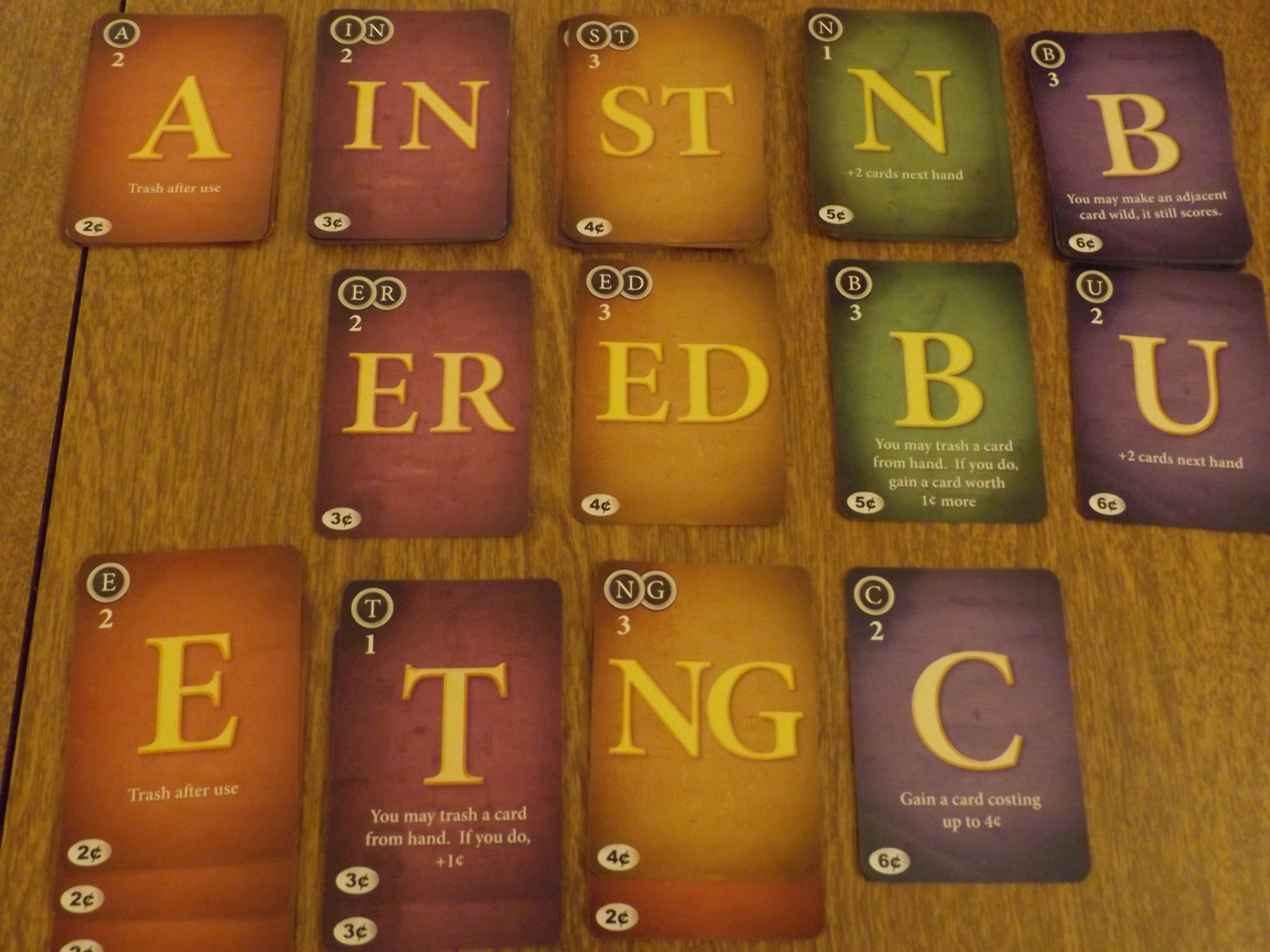
On your next turn, you use up to all of the letters in your hand and the common vowel to spell a word. That word is worth a number of cents equal to the combined total of the value in the top left of each card used. For instance, if you spelled ‘s*lent’ using 4 of your starting letters, the common card, and 1 wild, it would be worth 5 cents. The wild is worth 0 cents.

Paberback Silent

With the cents earned from your word, you may buy new card(s). If you had 6 cents, you could buy 3 2-cost cards, 1 6-cost card, or any other combination that adds up to at most 6. Cards you buy go directly to your discard pile.

Paberback Buy Examples

After you buy your card(s), discard all cards from that turn, whether you played them or not. Repeat this process until the game ends.

Card Type and Abilities

Cards are either Letter cards or Fame cards.

Letter cards have higher cent values (for purchasing more cards) than the starter cards. They can also have abilities that trigger when used in a word. For instance, there is a P that costs 5 cents to buy, is worth 2 cents when played, and, when used as the first letter in a word, it is worth 2 more cents.

Some of these abilities include drawing additional cards at the end of your turn, gaining cards, trashing cards (removing cards your your deck), and even giving a one-time double word score.

PBExamples

Fame cards are either wilds or common cards. Wilds provide 0 cents when used in a word, common cards provide 1 cent. Fame cards are important because they are what give you points at the end of the game.

Your deck starts with 5 1-point wild cards, and there are 4 other wild cards that can be purchased during the game. The higher the cost, the more points it is worth at the end of the game.

PBFameCards

Common cards are worth 5 points at the end of the game. You get common cards by making words with at least 7 letters. To get the first common card, you need a 7+ letter word. The second common requires an 8+ letter word. 3rd requires 9+. Final requires 10+.

PBCommonCards

Game End

The game ends when 1 of 2 conditions is met.

  • Any 2 piles of fame cards are depleted

or

  • All of the common cards are depleted

Conclusions

I enjoy Paperback. I bought this for a family member that plays a lot of Words with Friends, and she loves this game. Paperback works well as a word game, and it works fairly well as a game in its own right.

As a word game, you get the same feeling of accomplishment when you create an excellent word. In addition, it’s generally not difficult to know the most potential points you can score in a hand, and it feels great when you find a word that does it. I generally see the word game enthusiasts chase after cards that let you draw more cards. This lets them create these impressive 7+ letter words which award the common cards. These long words are generally also worth significant cents, for buying.

For those of you who do not enjoy chasing massive words, you can go after individual high cents cards and fame cards. I frequently go this route. Doing this lets me buy the fame cards, and I am frequently the player that ends the game. As a gamer, I do feel like the balance of the cards might not be perfect; the 4 or 5 cent letters and the single-use double word scores are just so powerful.

The other downside of Paperback is the potential length. When a player takes an incredibly long time to think of a word, the game can drag on. This is especially true if there are multiple people in a row taking a long time. In gaming, this phenomenon is known as Analysis Paralysis (AP). The game does address this by allowing players to ask for help. The helping player then gets a reward. In addition, there is a cooperative mode, but I have not played it yet. There are also a bunch of other “expansions” included in the base game. The expansions that I have tried haven’t been great.

Overall, Paperback works excellently as a game I can play with casual players. It works particularly well for fans of word games.

Sample Epic Open Draft

Epic Box

Foreword

In this article, I go through an entire sample Epic Open Draft. I will be drafting 40 cards per deck and cutting 10 each for 30 card decks. I am picking for both decks, but, since the cards are visible to both players constantly in this format, I don’t have to pretend that I don’t have complete knowledge. So I think it works. (This wouldn’t work for Dark Draft; however, you can expect to see something involving Dark Draft soon.)

After showing my picks, I explain why I picked the cards for each deck. Anytime I say A thinks this or B thinks that, I am referring to my own thought process. I use A and B to (hopefully) make it easier to follow as two separate drafts.

Round 1 (Player A First Pick)

Round 2 (Player B First Pick)

Round 3 (Player A First Pick)

Round 4 (Player B First Pick)

Round 5 (Player A First Pick)

Round 6 (Player B First Pick)

Round 7 (Player A First Pick)

Round 8 (Player B First Pick)

Round 9 (Player A First Pick)

Round 10 (Player B First Pick)

Round 11 (Player A First Pick)

Round 12 (Player B First Pick)

Round 13 (Player A First Pick)

Round 14 (Player B First Pick)

Round 15 (Player A First Pick)

Round 16 (Player B First Pick)

Round 17 (Player A First Pick)

Round 18 (Player B First Pick)

Round 19 (Player A First Pick)

Round 20 (Player B First Pick)

Final Decks and Explanations


Draft Conclusions

Kahuna Review

Kahuna BoxForeword

Kahuna is a short 2-player game that makes me feel clever. I really, really like feeling clever.

How to Play

Overview

Kahuna is all about timing, efficiency, and momentum. This is a game where each card is a potential bridge (or half of a negative bridge) used to control islands which by controlling you remove other bridges letting you control more islands. I let myself get carried away there purposefully, but the rules are actually fairly simple.

Kahuna In Progress

Goal

In this game you fight for control over 12 islands. Whoever controls the most islands, at 3 points in the game, scores points. The player with the most points at the end of the game wins.

The Turn

  1. Play any number of cards in hand
  2. Draw 0 or 1 card

Playing Cards

You gain control of islands by playing cards.

Each card has the name of an island on it. When you play that card, you place a bridge on any of the connections stemming from that island. For example, if I play an Aloa card, I can place a bridge on the Aloa-Bari connection, the Aloa-Duda connection, or the Aloa-Huna connection.

KahunaAloa

If placing this bridge grants you a majority of potential bridges controlled for an island, you remove all your opponent’s bridges touching that island and place one of your discs on the island. The disk shows that you control that island. For example, say I have the Aloa-Bari connection and my opponent has the Aloa-Duda connection. I then place a bridge on the Aloa-Huna connection (I could use either an Aloa or a Huna card to do this). I now have a majority on Aloa and would remove my opponent’s Aloa-Duda connection. This could cause your opponent to lose a majority on a different island. This in turn means they no longer control that island.

KahunaMajority1

KahunaMajority2

The second use for cards is to remove bridges. It takes 2 cards to remove 1 bridge. You can either use 1 card from each island or 2 cards from 1 island. For example, if I wanted to remove my opponent’s Aloa-Duda connection, I could use either 2 Aloa cards, 2 Duda cards, or 1 Aloa card and 1 Duda card.

KahunaRemove

Drawing Cards

At the end of your turn, you may draw 1 of 3 face up cards, 1 face down card, or choose not to draw. If your opponent chose not to draw on their turn, you must draw on your turn. Your hand size is 5 cards, if you have 5 cards in your hand at the end of your turn, you may discard a card face down to draw a card. If you draw a face up card, turn a card from the top of the deck face up to replace it.

KahunaDraw

Scoring

When you draw the last face up card of the deck, the round ends and scoring occurs. A game has 3 rounds. Bridges are not removed at the end of each round. Shuffle the discard pile to reform the deck for the next round.

  • After the 1st round ends, the player who controls the most islands gains 1 point.
  • After the 2nd round ends, the player who controls the most islands gains 2 points.
  • After the 3rd round ends, the player who controls the most islands gains 1 point for each island they control more than their opponent. So, if player A controls 6 islands and player B controls 3, player A would gain 3 points.
  • The player with the most points wins.

Conclusions

I enjoy this game. Like all of my favorite games, this game has a decent amount of depth to it. The rules are simple, but the more I play it, the more I realize. How much do you hoard cards? When is the best time to gain majority on an island/kick your opponent’s bridges off of islands? Which island connections are safe and which are risky? Do you want to expand your bridges on islands where you already have a majority? When do you want to not draw a card? How often should you remove bridges? These are a few of the interesting questions that arise when playing the game.

This game also has the potential for really huge, impressive moves. “I remove your bridge here, so I can play mine there and take control of this island. That then makes you lose control of this island so I will take control of that one too, kicking you off it entirely as well.” I also find it interesting that sometimes the most dangerous thing you can do is to gain control of an island.

Planning is highly rewarded in this game, but you can get lucky face up draws as well. You can mitigate this luck slightly by not drawing a face up card. This in turn doesn’t give your opponent a guaranteed new, situationaly perfect card. I very much still want to play this game more.

Constructed Epic Deck Round Up

Foreword

I have included links and pictures for all of my Constructed Epic decks below. Each post contains not only the deck list, but it also contains my revision history and explanations for the deck as well. I will update this post when I make changes to existing decks and/or add new ones.

As of 8/27/16, I am significantly more practiced at constructed now. Any deck without an update after this date is most likely at a lesser caliber than decks posted/updated on or after this date. I updated the decklists to be sorted by date last updated.

Core Set Only Deck for Digital Alpha

My Worlds 2016 Deck

My World’s Pyrosaur Deck (Posted: 12/1/16)

pyrosaurworlds

Pre-Worlds 2016 Decks

Uprising Demons (Posted: 12/7/16, created before Worlds)

Brute Force (Posted: 12/7/16, largely created before Uprising)

4 Color Army (Posted: 8/27/16)

4 Color Army

Pre-Origins 2016 Decks

Constructed Epic: Avenging Angel Control

Epic Box

Foreword

I have frequently heard people say Avenging Angel is overpowered. So, I made a deck focusing on it.

First Shot Deck List

Avenging Angel Control Deck

Good (37)

Slow (11)
3x Avenging Angel
3x High King
3x Palace Guard
2x Thundarus

Fast (16)
3x Angel of Mercy
3x Banishment
1x Inner Peace
3x Noble Unicorn
3x Resurrection
3x Vital Mission

0-Cost (10)
1x Brave Squire
3x Priest of Kalnor
3x Priestess of Angeline
3x White Dragon

Sage (22)

Slow (0)

Fast (15)
3x Lying in Wait
3x Psionic Assault
3x Thought Plucker
3x Transform
3x Wave of Transformation

0-Cost (7)
3x Forcemage Apprentice
2x Keeper of Secrets
2x Muse

Wild (1)

Slow (0)

Fast (1)
1x Lightning Storm

0-Cost (0)

First Shot Explanation

This is a control deck. The goal of the deck is to grind through your opponent. I brought no bounce, I focused on banishing removal, and I included discarding. Ideally, I want to slowly cripple my opponent so they are unable to deal with my Avenging Angel and/or Thundarus. Angel of Mercy, Resurrection, Priest of Kalnor, and Brave Squire are all included to help protect Avenging Angel as well.

With regards to Avenging Angel, I generally do not like it because it can be removed by so many cards. If your opponent is unable to remove Avenging Angel, a 6/6, airborne, blitz, righteous, you-can’t-be-attacked-while-expended body is enormous. If I can control the game and get ahead, I would then play Avenging Angel to stay ahead.

A singleton Inner Peace is included because I can see myself running a bit low on cards. In this deck, I believe I would generally try to play a card for its primary effect every turn, when possible.

A singleton Lightning Storm is included for a couple reasons. Recurring 6 divisible damage is a nice way to deal with a decent amount of threats and do some damage. 6 recurring damage to the face is also an excellent finisher.

Forcemage Apprentices are largely included to deal with tokens, since the deck has trouble dealing with them otherwise, I assume. They are also a nice reliable way to deal damage to the face.

Almost always you want to use Banishment on your turn so you can draw the card.

Vital Mission can be used on Thundarus to gain 10 health and draw 2 cards. Since Thundarus is also unbanishable, it stays in play. (Yes, that is how that works.)

I would recommend not playing this deck against newer players. Control decks are literally designed to be incredibly frustrating to play against.

3/11/16 Playtest Notes

This deck seems solid. I feel like it has answers to most of the decks that scare me currently. The only archetype I feel it is currently weak to is token decks.

Tyrants Initial Rework Decklist (3/29/16)

Avenging Angel Control 2

Good (29)

Slow (9)
3x Avenging Angel
3x High King
3x Markus, Watch Captain

Fast (11)
3x Angel of Mercy
3x Noble Unicorn
3x Resurrection
2x Royal Escort

0-Cost (9)
3x Paros, Rebel Leader
2x Priest of Kalnor
2x Priestess of Angeline
2x White Dragon

Sage (30)

Slow (6)
3x Elara, the Lycomancer
3x Knight of Shadows

Fast (15)
3x Lying in Wait
3x Psionic Assault
3x Temporal Shift
3x Thought Plucker
3x Wave of Transformation

0-Cost (9)
3x Forcemage Apprentice
3x Keeper of Secrets
3x Muse

Wild (1)

Slow (0)

Fast (1)
1x Lightning Storm

0-Cost (0)

Tyrants Initial Rework Explanation (3/29/16)

Removed: Palace Guard, Thundarus, Banishment, Inner Peace, Vital Mission, Brave Squire, and Transform

Avenging Angel Control 2 Remove

Added: Markus, Watch Captain, Royal Escort, Paros, Rebel Leader, Elara, the Lycomancer, Knight of Shadows, and Temporal Shift

Avenging Angel Control 2 Add

Temporal Shift replaces Transform since it essentially does the same thing for this deck, but it draws a card for me and doesn’t leave a wolf. It removes a champion and banishes a card.

Elara, the Lycomancer functions as a second reusable banishment champion that needs to be answered by my opponent.

Knight of Shadows is a second win condition and more forced discard for my opponent.

Paros, Rebel Leader is another threat that needs to be dealt with at 0-cost. If nothing else, it will give me more chump blockers and can block/break non-demon tokens.

Royal Escort is included specifically to protect my Avenging Angel and my reusable banishment champions. It also has some health gain.

Markus, Watch Captain is included because I think this deck is a bit vulnerable to tokens. If nothing else, it is a 10/10 loyalty 2 -> draw a card. As an added perk, it helps against forced discard.

Overall, I removed a net 6 removal cards, but I am hoping the deck will be more solid and consistent now.

Derik M 3/31/16 Adjustment

These changes are based on Derik M’s comment below, posted on 3/31/16. See comments for further discussion. I really enjoy seeing comments and discussion. Feel free to jump in below with thoughts or questions.

Reductions: -3 Temporal Shift, -1 Royal Escort, and -1 Paros, Rebel Leader

AAControlDerikMRemove

Additions: +3 Transform, +2 Palace Guard

AAControlDerikMAdd

After reading Derik M’s comment and thinking it through. I now currently agree that Temporal Shift is not strong enough for this deck, generically. It is being replaced by Transform. I do not think this deck needs to worry about drawing 1 more card, returning a threat to hand isn’t ideal for a control deck, and the wolf probably isn’t a big enough issue to worry about.

In addition, I am cutting 1 of each of my support Paros, Rebel Leader and Royal Escort to make room for 2 Palace Guards.

I really, really wanted to use Temporal Shift, and I personally still think it has its place. But, I currently agree with Derik M that it isn’t right for this deck, generically.

Based on the meta, I might change my mind and try to cut some more cards to make room for it. For instance, if Thundarus is dominating, I could cut one or both of the Palace Guards. Temporal Shifts can lock a player down while giving me time to draw into my Transforms, Wave of Transformations, or Elara, the Lycomancers…I do like the idea of getting someone to continually replay a no Tribute or Loyalty champion while I draw a card and they banish a card from hand each turn…I am going to have to do some more playtesting.

5/26/16 Rework v3 Decklist

AAControl3

Evil (9)

Slow (0)

Fast (6)
3x Plague
3x Zombie Apocalypse

0-Cost (3)
3x Guilt Demon

Good (27)

Slow (11)
2x Avenging Angel
3x High King
3x Markus, Watch Captain
3x Palace Guard

Fast (10)
2x Angel of Light
3x Angel of Mercy
3x Noble Unicorn
2x Vital Mission

0-Cost (6)
3x Blind Faith
3x White Dragon

Sage (24)

Slow (6)
3x Knight of Shadows
3x Mist Guide Herald

Fast (10)
3x Psionic Assault
1x Temporal Shift
3x Thought Plucker
3x Wave of Transformation

0-Cost (8)
2x Arcane Research
3x Amnesia
3x Muse

Wild (0)

5/26/16 Rework v3 Explanation

Removed: 1 Avenging Angel, 3 Resurrection, 1 Royal Escort, 2 Paros, Rebel Leader, 2 Priest of Kalnor, 2 Priestess of Angeline, 3 Elara, the Lycomancer, 3 Lying in Wait, 3 Transform, 3 Forcemage Apprentice, 3 Keeper of Secrets, 1 Lightning Storm

AAControl3Remove

Added: 3 Plague, 3 Zombie Apocalypse, 3 Guilt Demon, 1 Palace Guard, 2 Angel of Light, 2 Vital Mission, 3 Blind Faith, 1 White Dragon, 3 Mist Guide Herald, 1 Temporal Shift, 2 Arcane Research, 3 Amnesia

AAControl3Add

I reworked this decklist, again, primarily because the 0-cost cards were not working for it.

The Priest of Kalnors, Paros Rebel Leaders, and Forcemage Apprentices were the biggest problems. Since none of these recycle or let you draw 2 cards instead, they contributed significantly to the deck’s insufficient draw. Further, since the deck was weak on draw, I couldn’t afford to have multiple of these cards filling my ever-diminishing hand.

To fix this issue, I added 7 0-cost recycle cards, the Amnesias, Blind Faiths, and 1 more White Dragon. Amnesia is an incredibly strong control card since the discard pile is very important, even if your opponent is just using it to recycle. Blind Faith is an absolutely incredible card in so many situations. White Dragon is one of the best cards in Good. Since I switched to these 0-cost cards, I wasn’t forced into bringing much more draw, but the deck still became much more consistent.

Guilt Demon was added for more discard pile hate.

Arcane Research, as discussed in the comments, is excellent because at best it can find exactly what you need and at worst it replaces itself. About to die to burn, Arcane Research for Angel of Light. Draka comes blitzing at your face, Arcane Research for Wave of Transformation. In addition, for the cost of showing your opponent 1 card (not totally insignificant), you can always just banish itself to draw a replacement for it. Arcane Research is just an excellent card for constructed overall.

The other reason I reworked this deck was to make it more resilient to human token swarms. Plague and Zombie Apocalypse can break a swarm, and Blind Faith can strip unbreakable or even just blitz if needed. (Blind Faith would not remove the attack buff from effects like Courageous Soul, but it would remove Standard Bearer‘s buff.) Zombie Apocalypse also works nicely with my Wave of Transformations for non-targeting off-turn removal. (Markus afterwards on my turn is a satisfying follow up.)

Angel of Light was added for a bit of extra help against aggressive decks like burn, and it works nicely with Angel of Mercy. Elara was removed specifically because it does not work with Angel of Mercy.

Mist Guide Herald is nice primarily because I have so many strong champions I want to hit already.

Vital Mission is included almost exclusively for off-turn removal. It is still possible that I replace them for other removal, potentially adding the Lying in Waits or Transforms back into the deck. I’m still experimenting with Temporal Shift since I am still a little worried about card draw.

Overall the deck has been working much better for me. I’m still not sold on everything, but the 0-cost shift has made a noticeable improvement.